SELF INSTRUCTION IN MODERN LACE MAKING by FRANCES HOWLAND
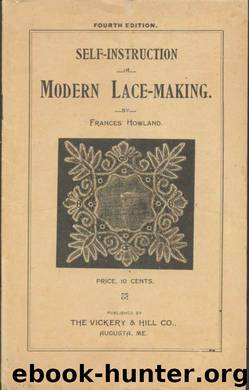
Author:FRANCES HOWLAND
Language: eng
Format: epub
Tags: lace; crochet; crafts; needlework; lace making; lace-making; tatting
KO. 6g,
For description see page 16.
For this, several stitches are worked close together, not separated by any stitch. No. 12 and No. 13 show the method of working clearly, and form a firm and pretty edging; No. 14 gives a dotted design of two stitches; No. 15 has four, alternating with two stitches ; No. 16, three alternating with single rows, and No. 17 the plain dotted pattern with three stitches together. We have in No. 18 a point-de-Sorrento stitch in which the thread is carried back, the next row of stitches being worked over this thread as well as in previous loop. From this many other effective stitches may be made. No. 19 shows the method of working the looped buttonhole stitch—point Turque. This stitch is not at all difficult, but requires a little practice to work it evenly and well—in fact, this may be said of all needlework. No. 20 gives a pattern worked, as No. 19, over cross threads, and No. 21a dotted pattern, consisting of a plain and looped stitch, which is a pretty variation of No. 18, without the cross thread. No. 22 to No. 32 shows point de Venise—buttonhole stitch backwards. This consists of a common buttonhole stitch, as a kind of foundation, then another looped into it as shown in No. 22. No. 23 gives this stitch as a pattern, with a line of plain buttonhole stitch, forming a stripe. No. 24 shows in large size the method of working a most beautiful variation of this useful stitch, either for an outer edge or for patterns, by looping three or four stitches into the first large buttonhole stitch, which makes a thick scallop. No. 25 gives this edging in Honiton size, and in No. 26 the stitches are taken farther apart, making it more open. No. 27 is made by having a row of single buttonhole stitches in returning. No. 28 gives a variation with the same thick scallops worked backwards and forwards, and is very pretty as a guipure ground between thick arabesque patterns. By working downwards in the large buttonhole loop the pattern shown in No. 29 is formed, which is equally pretty, formed in single lines for inclosing large patterns. No. 30, No. 31 and No. 32 are variations of the same idea, two or three buttonhole stitches being worked close together, downward. No. 33 shows the herringbone or plain Russian stitch, to form which the single cross-stitch at very short intervals, is worked into the braid. No. 34 shows a double cross-stitch, consisting of two lines, lying over each other, and No. 35 gives the same stitch, fastened by a buttonhole stitch made across it. These stitches are particularly useful in joining strips or lengths of braid. No. 36 shows again the plain twisted bars, simply varying the method of formation ; No. 37 is the simple cross-stitch, twisted in returning; No. 38 is the point d'Alencon stitch, used in filling, and consisting of loose bars or threads taken
Download
This site does not store any files on its server. We only index and link to content provided by other sites. Please contact the content providers to delete copyright contents if any and email us, we'll remove relevant links or contents immediately.
On Writing A Memoir of the Craft by Stephen King(4997)
The Doodle Revolution by Sunni Brown(4828)
A Simplified Life by Emily Ley(4213)
Mummy Knew by Lisa James(3729)
Marijuana Grower's Handbook by Ed Rosenthal(3716)
Better Homes and Gardens New Cookbook by Better Homes & Gardens(3628)
Figure Drawing for Artists by Steve Huston(3491)
Paper Parties by Erin Hung(3448)
Draw Your Day by Samantha Dion Baker(3411)
The Genius of Japanese Carpentry by Azby Brown(3344)
The Code Book by Simon Singh(3250)
Japanese Design by Patricia J. Graham(3213)
Dangerous Girls by Haas Abigail(3070)
The Curated Closet by Anuschka Rees(3004)
Lions and Lace by Meagan Mckinney(2999)
How to Make Your Own Soap by Sally Hornsey(2943)
The Checklist Manifesto by Atul Gawande(2892)
The Wardrobe Wakeup by Lois Joy Johnson(2817)
Keep Going by Austin Kleon(2816)
